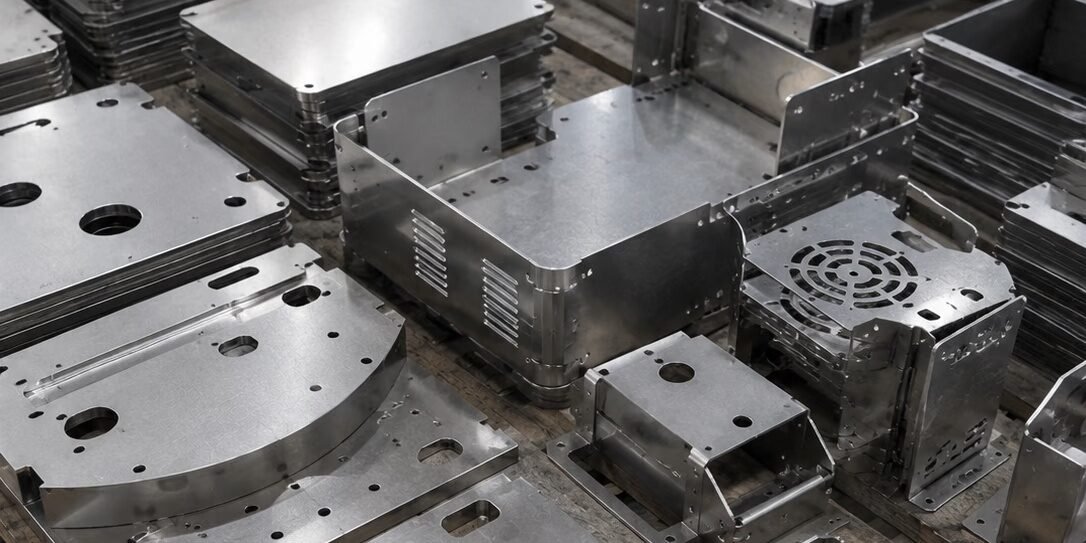
Modern precision sheet metal fabrication has evolved far beyond traditional cutting, bending, and welding. For high-end applications in automotive components, electronics enclosures, and industrial automation, mastering material behavior and micro-level tolerances is essential for structural integrity and aesthetic perfection.
Controlling Material Springback and Cumulative Tolerances
Predictive Springback Modeling: When metal sheets undergo CNC bending, elastic recovery invariably causes an angular shift upon load release. Utilizing Finite Element Analysis (FEA) is critical for high-strength steels and aerospace-grade aluminum alloys to accurately simulate springback trajectories and pre-compensate tooling geometry.
Mitigating Cumulative Error: Complex sheet metal assemblies require multiple sequential bends and stampings. Minor angular deviations in individual steps can compound rapidly, causing critical out-of-tolerance final assemblies. Advanced facilities deploy closed-loop CNC systems and inline optical measurement to lock sub-millimeter tolerances across multi-stage processes.
Thermal Management and Distortion Control in Welding
Heat-Affected Zone (HAZ) Optimization: While high-power laser cutting delivers exceptional speed and precision, localized heat can induce thermal distortion or edge oxidation on thin sheets. Optimizing assist gas purity, pressure, and cutting path speeds minimizes the HAZ to preserve material integrity.
Welding Residual Stress Management: Thin-walled sheet components are highly susceptible to warping under heat. Employing pulsed laser welding or micro-TIG welding, combined with rigid precision fixture clamping and symmetric jump-welding sequences, effectively restrains thermal warping and ensures structural flatness and seal integrity.
Advanced DFM (Design for Manufacturability) Principles
Minimum Bend Radius Matching: Sheet thickness (t) and internal bend radii must align with material ductility. Undersized radii stretch outer fibers beyond their tensile limit, resulting in micro-cracking or surface tearing.
Hole-to-Bend Clearance Rules: Laser-cut or punched holes positioned too close to deformation zones warp into elliptical shapes during bending. Maintaining a safe distance—typically greater than twice the material thickness plus the bend radius—protects hole geometry.
Precision sheet metal fabrication requires rigorous technical discipline across every manufacturing phase. Zehan FAB (https://zehanfab.com/) bridges the gap between complex metal manufacturing and precision injection molding, delivering integrated, high-reliability structural component solutions from initial DFM analysis to final surface finishing.